"I have a box for 'Les Huguenots.'
Have you heard the De Reszkes?"
|
|
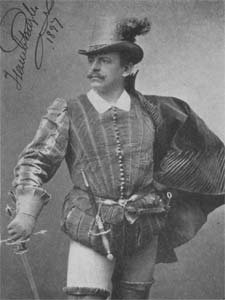
An autographed picture of Jean De Reszke playing Raoul in Les Huguenots, 1897 |
|
Les Huguenots by Giacomo Meyerbeer
(1791-1864) is a five-act opera first performed at the Paris Opera
in 1836. It recounts the story of several romances against the backdrop
of the events leading up to the Saint Bartholomew's Day Massacre, a widespread massacre of French Protestants, known as Huguenots, on August 24, 1572.
The Oxford Dictionary of Opera lists two De Reszke brothers:
Jean (1850-1925), a tenor; and Édouard (1853-1917), a bass. They
performed together in Les Huguenots many times in New York,
where they were leading singers at the Metropolitan Opera, and on
tour in London. A sister, Josephine (1855-1891), sang soprano roles,
but retired upon her marriage in 1884, too early for the chronology
of Hound. Of the three singing siblings, Jean was the most
acclaimed for the beauty and versatility of his voice.
Holmes displays an appreciation for music
throughout the stories. Besides being an accomplished violinist,
he attends concerts and operas. In "The Red-Headed League," he reveals
his preference for German music because it is more "introspective"
than Italian or French.
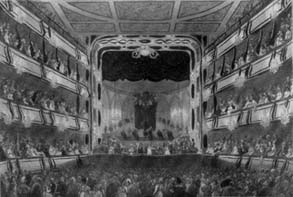
"Box seats," like the ones Holmes has obtained tickets for, are
located at the sides and rear of the hall (see the picture of Covent
Garden, above). The cheaper seats down below in the "stalls"—what
we know as the orchestra—offered less luxury and privacy, and, paradoxically,
less opportunity to see and be seen by high society.