|
 A
Double-Barreled Detective Story
—by Mark Twain
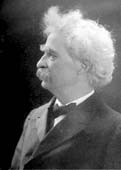
American author and satirist Mark Twain (actually Samuel Clemens,
1835-1910) wrote a parody of Sherlock Holmes stories in 1902, soon
after reading The Hound of the Baskervilles. In this pastiche,
a child is born with a hound's heightened sense of smell because
his mother was frightened by dogs when she was pregnant with him.
The main attraction of the story is a pretentious and bumbling Sherlock
Holmes who visits an American mining camp, where he is called upon
to solve a mystery, only to be outdone by the young man who can
follow a scent like a hound. At first, the miners are quite impressed
with Sherlock and enjoy watching him think:
Meantime
the road in front of the tavern was blocked with villagers waiting
and hoping for a glimpse of the great man. But he kept his room,
and did not appear. None but Ferguson, Jake Parker the blacksmith,
and Ham Sandwich had any luck. These enthusiastic admirers of
the great scientific detective hired the tavern's detained-baggage
lockup, which looked into the detective's room across a little
alleyway ten or twelve feet wide, ambushed themselves in it, and
cut some peep-holes in the window-blind. Mr. Holmes's blinds were
down; but by and by he raised them. It gave the spies a hair-lifting
but pleasurable thrill to find themselves face to face with the
Extraordinary Man who had filled the world with the fame of his
more than human ingenuities. There he sat—not a myth, not a shadow,
but real, alive, compact of substance, and almost within touching
distance with the hand.
"Look at that head!" said Ferguson,
in an awed voice. "By gracious! that's a head!"
"You bet!" said the blacksmith,
with deep reverence. "Look at his nose! look at his eyes! Intellect?
Just a battery of it!"
"And that paleness," said Ham Sandwich.
"Comes from thoughtthat's what it comes from. Hell! duffers like
us don't know what real thought is."
"No more we don't," said Ferguson.
"What we take for thinking is just blubber-and-slush."
"Right you are, Wells-Fargo. And
look at that frown—that's deep thinking—away down, down,
forty fathom into the bowels of things. He's on the track of something."
"Well, he is, and don't you forget
it. Say—look at that awful gravity—look at that pallid solemness—there
ain't any corpse can lay over it."
"No, sir, not for dollars! And it's
his'n by hereditary rights, too; he's been dead four times a'ready,
and there's history for it. Three times natural, once by accident.
I've heard say he smells damp and cold, like a grave. And he—"
" 'Sh! Watch him! There—he's got
his thumb on the bump on the near corner of his forehead, and
his forefinger on the off one. His think-works is just a-grinding
now, you bet your other shirt."
"That's so. And now he's gazing
up toward heaven and stroking his mustache slow, and—"
|