Issue 8 : Hound, Chapters 10 and 11
I shrugged my shoulders. "If
he were safely out of the country it would relieve the taxpayer of a burden."
In Chapter VI of Hound, Selden is described as "the Notting Hill
murderer." Watson adds:
I remembered the case well, for it was one in which Holmes had taken an interest on account of the peculiar ferocity of the crime and the wanton brutality which had marked all the actions of the assassin. The commutation of his death sentence had been due to some doubts as to his complete sanity, so atrocious was his conduct.
It seems strange that Dr. Watson and
Sir Henry would be unconcerned about letting loose a vicious murderer
on the unsuspecting population of South America, simply because his absence
from Dartmoor Prison would relieve the English taxpayer from the burden
of supporting him.
Conditions at Dartmoor had improved slightly since the previous century,
but taxpayers' money was certainly not being wasted on frills. In Five
Years' Penal Servitude By One Who Has Endured It (1877), the anonymous
author describes life in Dartmoor prison at around the time of Selden's
imprisonment. Sadly, he describes a merely comfortable hammock as a "luxury."
[My cell] was about as large as a second-class state room on board an emigrant ship. The cell was 7 feet long by 4 feet broad, and 8 feet high; by the side of the door was a narrow window of rough plate glass, beneath which was a small flap-table, and that had to be let down when the hammock was slung. … My attention was drawn next to the ventilation of my new abode. This was on a very primitive principle. There was a gap about 5 inches deep at the bottom of the door to let the air in. … There is one luxury a convict certainly has, and that is a good warm bed, and after a day on the bogs of Dartmoor he needs it. There is no bed in a hammock, but a man has two good blankets (three in winter), a capital rug, and two stout coarse linen sheets, with a wool or hair pillow. A great many of the prisoners never slept in such good beds when free men.
He also describes some of the men he was incarcerated with:
It has been my sad experience to have met at Dartmoor with creatures in human form who seem to be of a different species to ordinary men. They are mere brutes in mind and demons in heart. … The very worst of the characters I have been brought into contact with have generally belonged to a class known as roughs, and the worst of all are London roughs. This class appear to me to be almost irreclaimable, and not at all amenable to any ordinary moral influence. As a rule, they are as cowardly as they are brutal—their animal instincts and propensities predominate to the almost total exclusion of any intellectual or human feeling, and with them, I fear, there is but one mode of effectually dealing. Brutes they are, and as brutes only can they be punished and coerced, and that is by the Lash.
Like Watson—and many Victorians—this
anonymous prisoner sees those who have committed heinous crimes as mere
animals who are not entitled to human consideration. I am certainly
developing the wisdom of the serpent….
Watson feels that he is developing wisdom mixed with guile, characteristic
of the serpent in folklore.
…and he and the baronet played écarté afterwards.
Écarté is a two-person card game that resembles euchre.
It was much in vogue in England and France during the early 19th
century. Perhaps they are a bit behind the times in Dartmoor.
…a lady, who was sitting before a Remington typewriter….
E. Remington & Sons, a firearms company, took up the manufacture of typewriters
in 1816. In 1886, the typewriter component of the company was sold, becoming
the Remington Typewriter Company. The original manufacturer continues
to make firearms to this day.
…the dainty pink which lurks at the heart of the sulphur
rose.
Native to South America, the "sulphur rose" is the ancestor of modern
yellow roses.
There was something subtly wrong with the face, some coarseness
of expression, some hardness, perhaps, of eye, some looseness of lip which
marred its perfect beauty.
Conan Doyle skillfully chooses adjectives to describe the lady’s face—"coarseness,"
"hardness," "looseness"—that contain a subtly negative judgment of her
moral character.
I knew already that Sir Charles Baskerville had made Stapleton
his almoner upon several occasions….
Sir Charles had asked Stapleton to distribute alms, or charity, to local
people as his agent.
"My life has been one incessant persecution from a husband whom
I abhor. The law is upon his side, and every day I am faced by the possibility
that he may force me to live with him."
Divorce laws in England specified the few conditions under which a woman
could obtain a divorce. Without proof of extreme cruelty, a woman had
little chance of being allowed to separate from her husband. Conan Doyle
was a strong advocate for liberalization of these laws.
…and many hundreds of them are scattered throughout the
length and breadth of the moor.
In fact, relatively few of the remaining moor huts are complete enough
to serve as habitation or hiding place. Most are either ruined or reduced
to mere circles, since the thatch and wood that made up their roofs, and
all or part of their walls, disintegrated millennia ago.
"I have established a right of way through the centre of old Middleton's
park, slap across it, sir, within a hundred yards of his own front door.
What do you think of that? We'll teach these magnates that they cannot
ride rough-shod over the rights of the commoners, confound them! And I've
closed the wood where the Fernworthy folk used to picnic. These infernal
people seem to think that there are no rights of property, and that they
can swarm where they like with their papers and their bottles."
On the same day, Frankland succeeded in having two contradictory judgments
passed: one that exalted the rights of the commoner over the larger landholder,
and another that reaffirmed the right of private property. No wonder that
he is often burned in effigy by disgruntled townsfolk. …stood
upon the flat leads of the house.
The telescope sits on the strips of lead used for roofing the house.
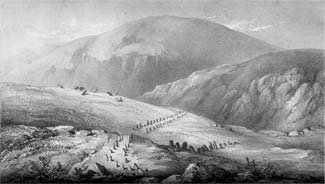 The barren scene, the sense of loneliness,
and the mystery and urgency of my task all struck a chill into my
heart. The boy was nowhere to be seen. But down beneath me in a
cleft of the hills there was a circle of the old stone huts, and
in the middle of them there was one which retained sufficient roof
to act as a screen against the weather.
The barren scene, the sense of loneliness,
and the mystery and urgency of my task all struck a chill into my
heart. The boy was nowhere to be seen. But down beneath me in a
cleft of the hills there was a circle of the old stone huts, and
in the middle of them there was one which retained sufficient roof
to act as a screen against the weather.At right, a rocky, desolate moor scene like the one Watson might have crossed in search of the mysterious stranger. From Samuel Rowe's A Perambulation of the Ancient and Royal Forest of Dartmoor (1848).
…a pannikin…."
A small pan.
"It is a lovely evening, my dear Watson," said a well-known
voice. "I really think that you will be more comfortable outside
than in."
Conan Doyle—through Watson himself—has given us all
the clues we need to figure out the identity of this mysterious
"stranger." We have been told that he is a gentleman, that he is
tall and slender, has Spartan habits, and is able to withstand difficult
and trying conditions. Cleverly, Conan Doyle mixes clear hints about
who he must be with mysterious innuendos. An example from Chapter
9, when Watson sees the stranger standing on a tor in the moonlight:
He stood with his legs a little separated, his arms folded, his head bowed, as if he were brooding over that enormous wilderness of peat and granite which lay before him. He might have been the very spirit of that terrible place.
Now, as the stranger speaks
for the first time, we have our final clue—and yet Conan Doyle waits
until the next issue to confirm the plot twist that he has just
unveiled.
Sherlock Holmes in Stamps
During the last 150 years, the image of Sherlock Holmes with deerstalker
and magnifying glass has become a potent symbol, instantly recognizable
the world over. Nearly a dozen countries have printed postage stamps
representing the Great Detective, his constant companion Dr. Watson,
or images from the stories they have appeared in together. See "The
Philatelic Sherlock Holmes," by Steve Trussell, at www.trussel.com/detfic/sholmes.htm
for more information.
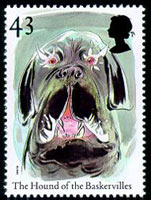
First sold on May 13, 1997, this British stamp representing the
Hound of the Baskervilles shows the flames dancing around his eyes
and jaws as triangular white shapes.
 |
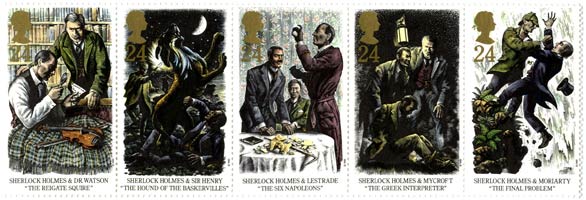
Another British stamp commemorating Hound
(October 13, 1993), appears with a selection of pictures from other
stories. In each picture, a letter of the name "Doyle" can be found,
not in order. Be warned—the letters are very small. You might need
your magnifying glass.
 |