Issue 4 : Hound, Chapters 3 and 4
 | |
 |
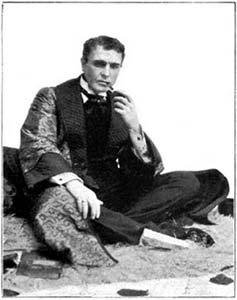
Actor William Gillette playing Holmes, wearing a dressing gown and thinking through a problem while smoking his pipe, from "Mr. William Gillette as Sherlock Holmes," The Strand Magazine, Vol. xxii, December 1901 |
 |
|
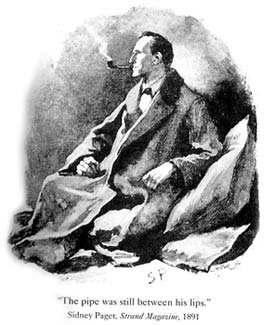
In "The Man with the Twisted Lip," Holmes stays up all night thinking over a problem | |
"…one a farrier…."
A farrier shoes horses, as opposed to a blacksmith, who forges metal items such as horseshoes. "Farrier" and "blacksmith" are often used interchangeably. The doctor's point is that the three people who claim to have seen the hound are levelheaded country folk, not normally given to flights of fancy.
"And you, a trained man of science, believe it to be supernatural?"
A doctor and a "trained man of science" like Mortimer, Conan Doyle had no trouble believing in the supernatural. He attended séances and believed in fairies.
"…who arrives at Waterloo Station…."
Opened in 1848 and rebuilt several times since, Waterloo Station serves the south and southwest rail corridor from London. It is located in Lambeth, across the Waterloo Bridge and about three miles from Baker Street.
"…fled to Central America, and died there in 1876 of yellow fever."
Found in Africa and South America, yellow fever is a viral infection transmitted by mosquitoes.
"I have had a wire that he arrived at Southampton this morning."
Southampton, located on the south coast of England, is a major port.
"…with merely local powers like a parish vestry…."
That is, a local parish council.
"When you pass Bradley's, would you ask him to send up a pound
of the strongest shag tobacco? Thank you. It would be as well if you
could make it convenient not to return before evening."
When Holmes has a problem to think through, he prefers to smoke shag
tobacco, a coarse, cheap tobacco with a high nicotine content favored
by workingmen.
"I therefore spent the day at my club…."
The gentleman's club was a refuge away from home for the middle- and
upper-class man, and lasted as a widespread institution well into
the 20th century. Club membership was very exclusive, and
was predicated on social standing, military service, interest in cricket,
hunting, etc.
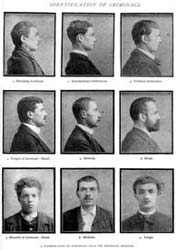 | |
| A partial catalogue of
foreheads from Bertillon's archive, from McClure's Magazine, March 1894 | |
"This small clump of buildings here is the hamlet of Grimpen, where our friend Dr. Mortimer has his headquarters."
The town of Grimpen and all the landmarks on the moor pointed out by Holmes are fictional.
Out of the envelope he took a half-sheet of foolscap paper folded into four.
Common paper, so named because in the 18th century it used to be imprinted with the image of a fool's cap.
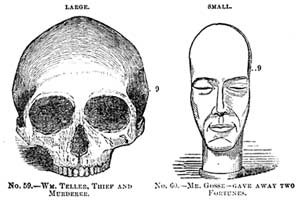
"The differences are obvious. The supra-orbital crest, the facial angle, the maxillary curve, the—"
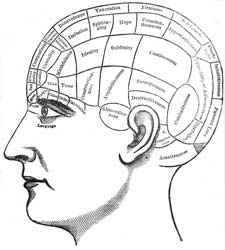
The "supra-orbital crest" is the protruding bone above the eye; "facial angles" are measured between the forehead and upper jaw and the jaw to the ear; the "maxillary curve" is the curve of the upper jaw. Phrenologists claimed to be able to read temperament, intelligence, and character through the shape of the skull, and used their pseudo-science to reinforce racial stereotypes, as Mortimer does.
 |
 | |
|
A phrenological chart from The New
Illustrated Self-Instructor In Phrenology and Physiology by
O.S. and L.N. Fowler, 1858 |
Phrenological
stereotypes | |
 |
 | ||
| Skull width was an indication of greed to phrenologists | The seat of "philoprogenitiveness," or parental love, was supposed to lie on the back of the skull, and—no surprise—was supposed to be larger in women than in men | ||
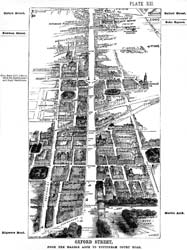 |
Oxford Street
crosses Regent Street at Oxford Circle |
"It's the pet story of the family, though I never thought of taking it seriously before."
There are numerous legends attached to old English homes and families, stories of hauntings or other mysterious happenings. Conan Doyle was inspired to write Hound when a friend told him a legend from Dartmoor that involved a hound.
Then, still keeping a hundred yards behind, we followed into Oxford Street and so down Regent Street.
Holmes and Watson would pass along Oxford Street from the bottom of the map [at left] and turn right on Regent Street at Oxford Circus. They would continue down Regent Street through Piccadilly Circus, make a left on Pall Mall, passing Trafalgar Square, and go on to The Strand and Charing Cross, where the (fictitious) Northumberland Hotel was located.
"…and then we will drop into one of the Bond Street picture galleries and fill in the time until we are due at the hotel."
On the map of Oxford Street, New Bond Street branches off to the right from Oxford Street, just below Regent Street, and leads into Old Bond Street where numerous art galleries are located. The Royal Academy of Art is nearby.