Issue 11 : Hound, Chapters 14 (part 2) and 15
"Phosphorus," I said.
"A cunning preparation of it," said Holmes, sniffing at the dead animal. "There is no smell which might have interfered with his power of scent."
Needless to say, this magical compound is an invention of Conan Doyle's. Phosphorus is extremely caustic--not to mention poisonous--and could burn through flesh right down to the bone.
"You have saved my life."
"Having first endangered it."
Sometimes, although not always, Holmes applies his brutal honesty to his own shortcomings.
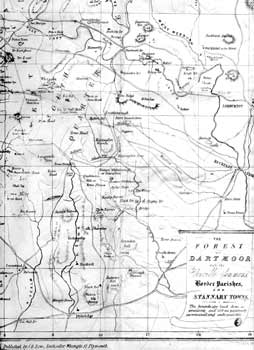 | |
| A partial map of the moor, with all its features marked: towns, tors, mires, barrows, etc. From Samuel Rowe, A Perambulation of the Ancient and Royal Forest of Dartmoor. | |
But the shock of the night's adventures had shattered his nerves, and before morning he lay delirious in a high fever, under the care of Dr. Mortimer. The two of them were destined to travel together round the world before Sir Henry had become once more the hale, hearty man that he had been before he became master of that ill-omened estate.
Poor Sir Henry Baskerville has succumbed to a well-known 19th-century malady affecting only literary characters: brain fever resulting from a shock. This "disease" is more metaphorical than real, and generally serves to impress upon the reader the gravity of the horror experienced by the character and the depth of his or her sensitivity. Without the high fever, the modern reader could accept "shattered nerves" as a 19th-century description of a malady we take quite seriously today: post-traumatic stress disorder.
Holmes sank to his waist as he stepped from the path to seize it, and had we not been there to drag him out he could never have set his foot upon firm land again.
One would assume that the third person here is Lestrade, not Mrs. Stapleton, although Watson does not say.
Holmes's enthusiasm for the chase is shown in his disregard for his own safety. He knows that Watson and Lestrade, both practical men, will be there to pull him out of the mire.
A huge driving-wheel and a shaft half-filled with rubbish showed the position of an abandoned mine.
The remains of tin mines, from the Bronze Age to the early 20th century, can be found upon the moor. Conan Doyle probably visited some ruins during his stay in Dartmoor.
Since the tragic upshot of our visit to Devonshire he had been engaged in two affairs of the utmost importance, in the first of which he had exposed the atrocious conduct of Colonel Upwood in connection with the famous card scandal of the Nonpareil Club, while in the second he had defended the unfortunate Mme. Montpensier from the charge of murder which hung over her in connection with the death of her step-daughter, Mlle. Carere, the young lady who, as it will be remembered, was found six months later alive and married in New York.
These cases remain, alas,
undocumented by either Watson or Conan Doyle.
"His wife had some inkling of his plans; but she had such
a fear of her husband—a fear founded upon brutal ill treatment—that
she dare not write to warn the man whom she knew to be in danger.
If the letter should fall into Stapleton's hands her own life would
not be safe. Eventually, as we know, she adopted the expedient of
cutting out the words which would form the message, and addressing
the letter in a disguised hand."
Even if a disguised letter fell into Stapleton's hands, would this
brilliant criminal genius be unable to figure out that his untrustworthy
wife must be the culprit?
"With characteristic promptness and audacity he set about
this at once, and we cannot doubt that the boots or chambermaid
of the hotel was well bribed to help him in his design."
The "boots" is the staff person in charge of polishing the gentlemen's
boots and shoes in a hotel at night. Losing two boots in a row would
be a serious matter, so the servant would have to have been well
bribed to take such a risk.
Sir Henry had paid six dollars for his new footwear. In today's
currency, those boots might cost over $100. Sir Henry only had three
pairs of boots, so the loss of two pairs would have been a significant
expense for a man who was not very well off until he came into his
inheritance.
"The more outré and grotesque an incident is the
more carefully it deserves to be examined…."
"Outré" is French for exaggerated or outrageous—a
favorite word of Holmes's.
"In doing so I held it within a few inches of my eyes, and
was conscious of a faint smell of the scent known as white jessamine."
"Jessamine," or white jasmine, is a night-blooming white flower
having a distinctive sweet and pungent scent.
 |
 | |
An
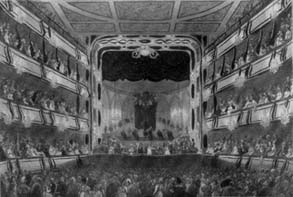
1808 view of the Covent Garden Theatre, after an engraving by S. Rawle, from H. Saxe Wyndham. Annals of Covent Garden Theatre from 1732 to 1897,
vol. I., 1906. |
The interior of Covent Garden Theatre, after an aquatint by Pulin and Rowalndson, dated 1808 | |
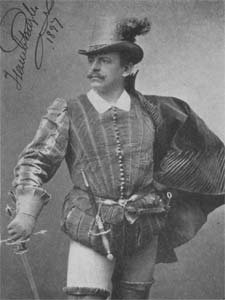 | ||
| An autographed picture of Jean De Reszke playing Raoul in Les Huguenots, 1897 | ||
Les Huguenots by Giacomo Meyerbeer
(1791-1864) is a five-act opera first performed at the Paris Opera
in 1836. It recounts the story of several romances against the backdrop
of the events leading up to the Saint Bartholomew's Day Massacre, a widespread massacre of French Protestants, known as Huguenots, on August 24, 1572.
The Oxford Dictionary of Opera lists two De Reszke brothers:
Jean (1850-1925), a tenor; and Édouard (1853-1917), a bass. They
performed together in Les Huguenots many times in New York,
where they were leading singers at the Metropolitan Opera, and on
tour in London. A sister, Josephine (1855-1891), sang soprano roles,
but retired upon her marriage in 1884, too early for the chronology
of Hound. Of the three singing siblings, Jean was the most
acclaimed for the beauty and versatility of his voice.
Holmes displays an appreciation for music
throughout the stories. Besides being an accomplished violinist,
he attends concerts and operas. In "The Red-Headed League," he reveals
his preference for German music because it is more "introspective"
than Italian or French.
"Box seats," like the ones Holmes has obtained tickets for, are
located at the sides and rear of the hall (see the picture of Covent
Garden, above). The cheaper seats down below in the "stalls"—what
we know as the orchestra—offered less luxury and privacy, and, paradoxically,
less opportunity to see and be seen by high society.
—by Mark Twain
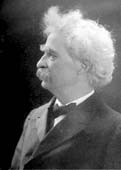
American author and satirist Mark Twain (actually Samuel Clemens, 1835-1910) wrote a parody of Sherlock Holmes stories in 1902, soon after reading The Hound of the Baskervilles. In this pastiche, a child is born with a hound's heightened sense of smell because his mother was frightened by dogs when she was pregnant with him. The main attraction of the story is a pretentious and bumbling Sherlock Holmes who visits an American mining camp, where he is called upon to solve a mystery, only to be outdone by the young man who can follow a scent like a hound. At first, the miners are quite impressed with Sherlock and enjoy watching him think:
Meantime the road in front of the tavern was blocked with villagers waiting and hoping for a glimpse of the great man. But he kept his room, and did not appear. None but Ferguson, Jake Parker the blacksmith, and Ham Sandwich had any luck. These enthusiastic admirers of the great scientific detective hired the tavern's detained-baggage lockup, which looked into the detective's room across a little alleyway ten or twelve feet wide, ambushed themselves in it, and cut some peep-holes in the window-blind. Mr. Holmes's blinds were down; but by and by he raised them. It gave the spies a hair-lifting but pleasurable thrill to find themselves face to face with the Extraordinary Man who had filled the world with the fame of his more than human ingenuities. There he sat—not a myth, not a shadow, but real, alive, compact of substance, and almost within touching distance with the hand. "Look at that head!" said Ferguson, in an awed voice. "By gracious! that's a head!"
"You bet!" said the blacksmith, with deep reverence. "Look at his nose! look at his eyes! Intellect? Just a battery of it!"
"And that paleness," said Ham Sandwich. "Comes from thoughtthat's what it comes from. Hell! duffers like us don't know what real thought is."
"No more we don't," said Ferguson. "What we take for thinking is just blubber-and-slush."
"Right you are, Wells-Fargo. And look at that frown—that's deep thinking—away down, down, forty fathom into the bowels of things. He's on the track of something."
"Well, he is, and don't you forget it. Say—look at that awful gravity—look at that pallid solemness—there ain't any corpse can lay over it."
"No, sir, not for dollars! And it's his'n by hereditary rights, too; he's been dead four times a'ready, and there's history for it. Three times natural, once by accident. I've heard say he smells damp and cold, like a grave. And he—"
" 'Sh! Watch him! There—he's got his thumb on the bump on the near corner of his forehead, and his forefinger on the off one. His think-works is just a-grinding now, you bet your other shirt."
"That's so. And now he's gazing up toward heaven and stroking his mustache slow, and—"
"Now he has rose up standing, and is putting his clues together on his left fingers with his right finger. See? he touches the forefinger—now middle finger—now ring-finger—"
"Stuck!"
"Look at him scowl! He can't seem to make out that clue. So he—"
"See him smile!—like a tiger—and tally off the other fingers like nothing! He's got it, boys; he's got it sure!"
"Well, I should say! I'd hate to be in that man's place that he's after."
Later, Holmes sums up the case, using his famous "method":
When quiet fell, Mr. Holmes resumed:
"We perceive, then, that three facts are established, to wit: the assassin was approximately light-witted; he was not a stranger; his motive was robbery, not revenge. Let us proceed. I hold in my hand a small fragment of fuse, with the recent smell of fire upon it. What is its testimony? Taken with the corroborative evidence of the quartz, it reveals to us that the assassin was a miner. What does it tell us further? This, gentlemen: that the assassination was consummated by means of an explosive. What else does it say? This: that the explosive was located against the side of the cabin nearest the road—the front side—for within six feet of that spot I found it.
"I hold in my fingers a burnt Swedish match—the kind one rubs on a safety-box. I found it in the road, six hundred and twenty-two feet from the abolished cabin. What does it say? This: that the train was fired from that point. What further does it tell us? This: that the assassin was left-handed. How do I know this? I should not be able to explain to you, gentlemen, how I know it, the signs being so subtle that only long experience and deep study can enable one to detect them. But the signs are here, and they are reinforced by a fact which you must have often noticed in the great detective narratives—that all assassins are left-handed."
"By Jackson, that's so." said Ham Sandwich, bringing his great hand down with a resounding slap upon his thigh; "blamed if I ever thought of it before."
"Nor I!" "Nor I!" cried several. "Oh, there can't anything escape him—look at his eye!"
Twain's Holmes accuses the wrong man. Worse, the murder was committed right under Holmes's nose, and he was set up by the murderer to serve as an alibi. After Holmes pronounces his verdict, Stillman, the hound-man, proves him wrong point by point, parodying some of Holmes's words to Watson over Dr. Mortimer's walking stick at the beginning of Hound.
"The criminal is present, I believe. I will show him to you before long, in case I am right in my guess. Now I will tell you all about the tragedy, from start to finish. The motive wasn't robbery; it was revenge. The murderer wasn't light-witted. He didn't stand six hundred and twenty-two feet away. He didn't get hit with a piece of wood. He didn't place the explosive against the cabin. He didn't bring a shot-bag with him, and he wasn't left-handed. With the exception of these errors, the distinguished guest's statement of the case is substantially correct."
The full text of Twain's story is readily available on line.