














|
...stood upon the flat
leads of the house. 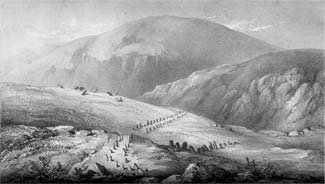 The barren scene, the sense of loneliness,
and the mystery and urgency of my task all struck a chill into my
heart. The boy was nowhere to be seen. But down beneath me in a
cleft of the hills there was a circle of the old stone huts, and
in the middle of them there was one which retained sufficient roof
to act as a screen against the weather.
The barren scene, the sense of loneliness,
and the mystery and urgency of my task all struck a chill into my
heart. The boy was nowhere to be seen. But down beneath me in a
cleft of the hills there was a circle of the old stone huts, and
in the middle of them there was one which retained sufficient roof
to act as a screen against the weather.At right, a rocky, desolate moor scene like the one Watson might have crossed in search of the mysterious stranger. From Samuel Rowe's A Perambulation of the Ancient and Royal Forest of Dartmoor (1848). ...a pannikin...."
Now, as the stranger speaks
for the first time, we have our final clue--and yet Conan Doyle waits
until the next issue to confirm the plot twist that he has just
unveiled. |
|
 |
 |
|
